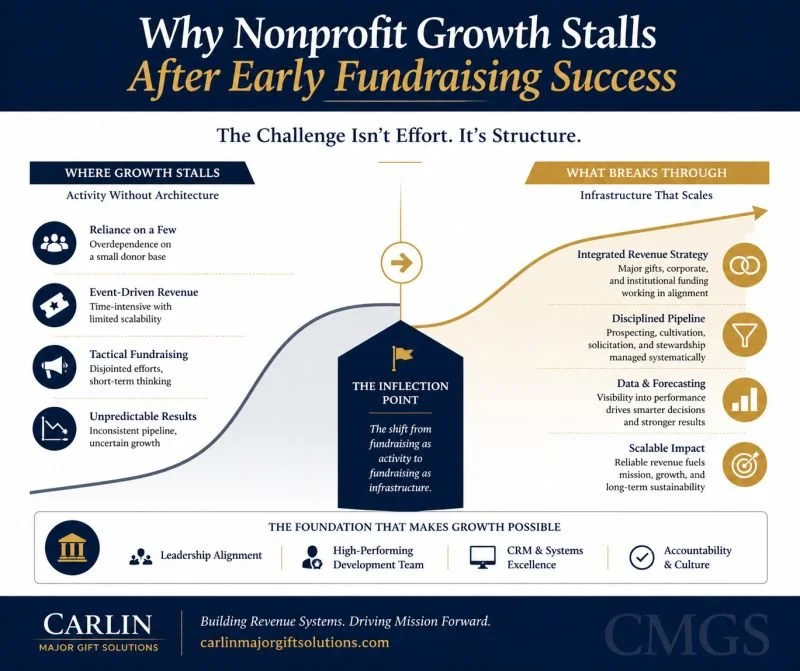
Why Nonprofit Growth Stalls After Early Fundraising Success
Early fundraising success can be misleading.
Many nonprofits reach a point where initial momentum, driven by a handful of major donors, strong events, or early institutional support, creates the appearance of a scalable model. But what often follows is stagnation. Not because the mission lacks demand, but because the underlying revenue system was never designed to scale.
The issue is rarely effort. It’s structure. Without a disciplined pipeline, integrated revenue streams, and clear forecasting, growth remains dependent on individual performance rather than institutional capability. Over time, that creates volatility instead of durability.
The organizations that break through this plateau make a deliberate shift, from fundraising as activity to fundraising as infrastructure. They align major gifts, corporate partnerships, and institutional funding into a unified system, supported by data, accountability, and leadership integration.
That’s the difference between early success and sustained growth.