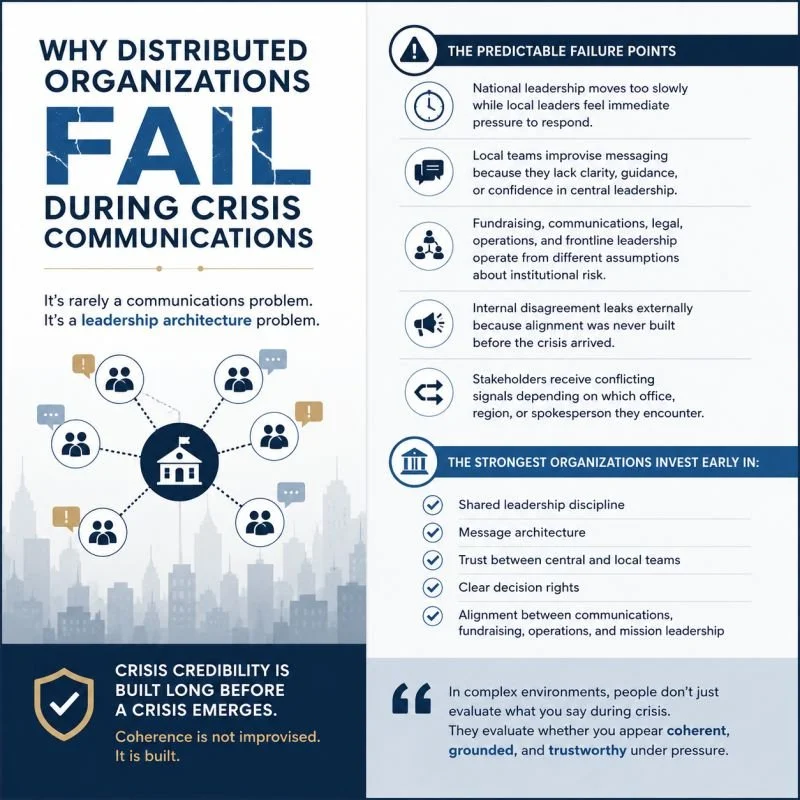
Why do distributed organizations so often fail during crisis communications?
Why do distributed organizations so often fail during crisis communications?
Usually, it is not because they lack intelligent people or good intentions.
It is because the organization discovers too late that it does not actually have: message alignment, decision clarity, or operational trust across its network.
In highly distributed organizations, nonprofits, universities, federated systems, global ministries, franchise-style networks, or multi-site institutions, crisis communications are rarely just “communications problems.”
They are leadership architecture problems.
The failure points are often predictable:
National leadership moves too slowly while local leaders feel immediate pressure to respond.
Local teams improvise messaging because they lack clarity, guidance, or confidence in central leadership.
Fundraising, communications, legal, operations, and frontline leadership operate from different assumptions about institutional risk.
Internal disagreement leaks externally because alignment was never built before the crisis arrived.
Stakeholders receive conflicting signals depending on which office, region, or spokesperson they encounter.
In these moments, organizations often overcorrect toward either: excessive centralization, or uncontrolled decentralization.
Both create new trust failures.
The strongest organizations understand that crisis credibility is built long before a crisis emerges.
They invest early in: shared leadership discipline, message architecture, trust between central and local teams, clear decision rights, and alignment between communications, fundraising, operations, and mission leadership.
In complex environments, people do not merely evaluate what an organization says during crisis.
They evaluate whether the organization appears coherent, grounded, and trustworthy under pressure.
That coherence is rarely improvised in real time.