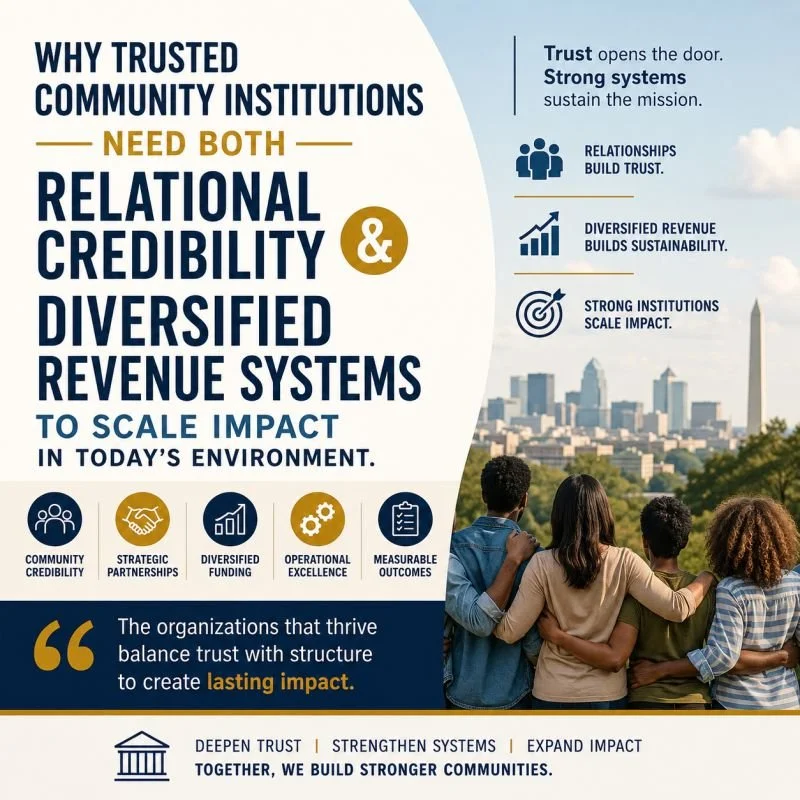
Why trusted community institutions need both relational credibility and diversified revenue systems to scale impact in today’s environment.
Why trusted community institutions need both relational credibility and diversified revenue systems to scale impact in today’s environment.
Many of the most trusted nonprofit and community-based institutions in the country were built over decades through deep relationships, consistent presence, and earned credibility within the communities they serve.
That trust matters immensely.
In many cases, it is the single greatest asset an organization possesses.
But in today’s environment, trust alone is no longer enough to sustain or scale long-term impact.
Organizations operating at the intersection of economic mobility, workforce development, housing stability, education, and community empowerment are facing increasing pressure from every direction:
Volatile public funding environments
Rising service demand
Donor fatigue
Economic uncertainty
Expanding operational complexity
Growing expectations around measurable outcomes and accountability
As a result, nonprofit leaders are being asked to do something increasingly difficult:
Preserve relational trust while simultaneously building more sophisticated, resilient, and diversified institutional systems.
The organizations that will thrive over the next decade are not necessarily those with the largest budgets or the loudest brands.
They will be the organizations that successfully integrate:
Deep community credibility
Strong leadership alignment
Cross-sector partnerships
Diversified revenue architecture
Operational discipline
Long-term strategic planning
In other words, mission alone is not enough. Infrastructure matters.
One of the most important shifts I believe nonprofit leaders must embrace is moving from episodic fundraising toward enterprise-wide revenue strategy.
That means:
Building balanced funding ecosystems across philanthropy, corporate partnerships, government support, and recurring individual giving
Strengthening forecasting and financial visibility
Aligning Boards more intentionally around growth and sustainability
Creating internal cultures where strategy, accountability, and mission reinforce one another rather than compete
Importantly, this work cannot come at the expense of relational leadership.
Communities do not trust systems.
They trust people.
They trust consistency.
They trust institutions that continue showing up with integrity over time.
The challenge for today’s leaders is learning how to scale organizational capacity without losing the relational foundation that made the institution matter in the first place.
That balance, between trust and structure, mission and sustainability, stability and growth, may ultimately define which institutions are able to expand their impact in the years ahead.